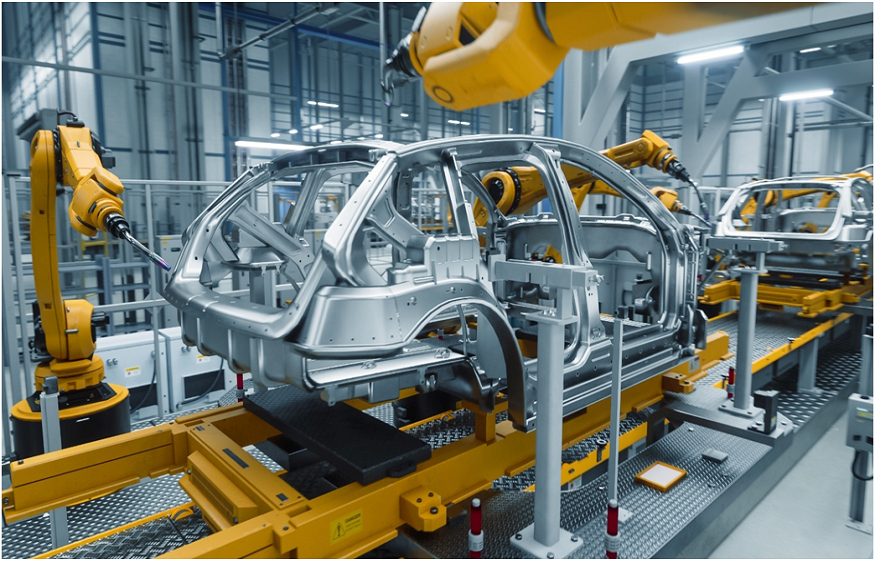
Talk to any plant manager in the automotive space and they’ll tell you the same thing. The systems aren’t the problem, until suddenly they are. A supplier goes quiet on a Tuesday, the line slows by Thursday, and by Friday someone’s pulling numbers from three different spreadsheets trying to explain what happened. It’s not a technology failure exactly. It’s a visibility failure.
That’s the honest case for investing in automotive ERP software. Not the glossy pitch about digital transformation. Just the practical reality that disconnected systems eventually cost more than they save.
Ramco’s ERP platform is built with that problem in mind. It’s designed for manufacturers who need the whole picture, procurement, production, quality, finance, and service, connected and working together.
What Does Automotive ERP Software Actually Do?
Most manufacturers already have software. The issue is that it doesn’t talk to itself. Your inventory tool doesn’t know what your production schedule looks like. Your finance team is reconciling numbers that your supply chain team updated two days ago.
Automotive ERP software fixes that by putting everything on one platform. When a purchase order gets raised, finance sees it. When a production job closes, inventory updates. Nobody’s waiting on a report because the data is already there.
For vehicle manufacturers, this matters in ways it doesn’t for other industries. You’re dealing with multi-level bills of materials, variant configurations, JIT delivery windows, and compliance audits. Generic software bends under that weight. Purpose-built auto industry management software handles it without workarounds.
How Does ERP for the Automotive Industry Handle Supply Chain Complexity?
Short answer: by giving you visibility you probably don’t have right now.
Ramco’s automotive supply chain ERP tracks inventory across every site in real time. It automates replenishment based on actual consumption rather than manual reorder points. And it gives your procurement team a supplier portal so purchase orders, confirmations, and delivery updates aren’t buried in email chains.
The part manufacturers often overlook is Tier 2 and Tier 3 supplier exposure. Most ERP tools stop at your direct suppliers. Ramco tracks further down the chain, which matters more than people realize until there’s a shortage of a sub-component they never thought to monitor.
Read More: Accelerating Enterprise Innovation with IBM ELM Solutions
Can Automotive ERP Improve Shop Floor Efficiency and Production Planning?
It can, but it depends on how deeply it’s actually connected to the floor.
Ramco’s vehicle manufacturing ERP system handles variant-based production, multi-level assemblies, and machine capacity planning. Work orders update in real time. If a component is delayed or a machine goes offline, planners see it immediately rather than finding out at shift handover.
What that translates to practically is fewer emergency reschedules, less unplanned overtime, and delivery commitments that your team can actually stand behind. Those aren’t dramatic outcomes but they add up fast in a high-volume operation.
How Does Ramco Automotive ERP Address Quality and Compliance?
This is probably where the platform earns its keep most clearly.
Quality in automotive manufacturing isn’t a department. It’s a process that runs through every stage of production. Ramco builds quality holds, inspection checkpoints, and non-conformance tracking directly into the workflow. Your team isn’t toggling between a separate quality system and the production system. It’s all in one place.
For compliance, Ramco supports IATF 16949 and ISO 9001 requirements out of the box. Warranty and recall management is tied to full production traceability, so when a quality issue surfaces six months after delivery, you’re not recreating history from paper records.
Manufacturers selling into multiple markets also get support for regional homologation requirements, which usually means one less custom integration to maintain.
Read More: Driving Software Excellence with ALM Consulting and Solutions
Why Are Automotive Manufacturers Moving to Ramco Over Other ERP Systems?
Honestly, a lot of it comes down to fit. Most large ERP vendors have automotive modules, but the platform was designed for something else and automotive was added later. The terminology doesn’t match. The workflows need to be customized. Implementation drags.
Ramco started with manufacturing. The automotive workflows, the costing models, the compliance structures, they reflect how the industry actually operates.
On the technical side, it’s cloud-native, so scaling to a new plant or region doesn’t require a separate infrastructure project. Pre-built integrations with MES, SCADA, and logistics platforms reduce custom development. And the mobile interface means managers get the same real-time data whether they’re on the floor or in a different city.
If your operation is still piecing together visibility from multiple systems, the cost isn’t always obvious until something breaks. Ramco’s automotive ERP software is worth evaluating before that happens.